SEO News
SEO Expert #1 In Online Marketing
  • Home
  • Houston SEO Expert
  • Houston SEO
  • SEO Houston
  • San Antonio SEO Expert
  • SEO Houston Pros
  • SEO
  • Blog
  • Texas SEO Expert
  • Houston SEO Consultant
  • The Single Best Strategy To Use For SEO Expert
  • Fascination About SEO Expert
  • A Review Of San Antonio SEO Consultant
  • The Fact About San Antonio SEO Company That No One Is Suggesting
  • Austin SEO Expert
  • Dallas SEO Expert

This day in search marketing history: February 28

2/27/2023

0 Comments


R.I.P., DMOZ

In 2017, DMOZ – The Open Directory Project that used human editors to organize websites — announced it was closing as of March 14.

By this time, DMOZ had been mostly forgotten as a resource. Perhaps the biggest surprise was that it took so long.

DMOZ was born in June 1998 as “GnuHoo,” then quickly changed to “NewHoo,” a rival to the Yahoo Directory at the time. It was acquired by Netscape in November 1998 and renamed the Netscape Open Directory. Later that month, AOL acquired Netscape, giving AOL control of The Open Directory.

Read all about it in RIP DMOZ: The Open Directory Project is closing.


Also on this day


New business openings nearly match pre-pandemic levels, Yelp says

2022: However, most major cities actually experienced a decrease in openings.


Etsy sellers to pay 30% higher transaction fees beginning in April

2022: A “considerable portion” of the revenue from the fee increase would be reinvested into the marketplace.


New Google Lighthouse extension for Firefox goes live

2020: Firefox had not yet reviewed the extension, so it got automatically categorized as “not a Recommended Extension.” 


Optimization scores, recommendations and their impact on Google Partner agencies

2020: Google said Partner agencies would continue to have “control and autonomy” as it put more emphasis on auto-generated recommendations.


Google’s new treatment of nofollow links has arrived

2020: Google was about to begin treating the nofollow link attribute as a hint, rather than a directive, for crawling and indexing.


Google experiments with public search profile cards

2020: Limited to India, the Google+-like feature gave personal brands and individuals some control over their own search results.


In feature battle with Google, Yelp improves restaurant waitlist functionality

2020: Yelp was rolling out its Notify Me feature, which supported Yelp Waitlist.


Google’s CTR answer just what you’d expect, and this is why SEOs go bananas

2019: Would Google give us a clear statement that outright said it does not currently use CTR directly in their core search ranking algorithm? Of course not.


Google opens complaint form to crack down on fake info in Maps

2019: Google launched the Business Redressal Complaint Form to allow searchers and users to report fraudulent activity relating to businesses Google Maps.


Amazon extends Sponsored Products to AmazonFresh for CPG brands

2019: Consumer packaged goods brands could extend their campaigns to their products sold in the AmazonFresh delivery program.


Multifaceted featured snippets begin rolling out in Google search results

2018: Multifaceted featured snippets would be surfaced for queries that were sufficiently broad enough to allow for more than one interpretation of what was submitted. 


Rand Fishkin leaves Moz, announces a new start-up

2018: After 17 years of working at the company he co-founded, Fishkin was starting a new company around influencer and audience intelligence.


Study: 11 voice search ranking factors analyzed

2018: 63.6% of voice search results didn’t use Schema at all. 


Google gives SEO tips on how to handle day-long site closures

2017: Tips from Google’s John Mueller on what to do if you needed to turn off your website for a period of time and worried your Google rankings will drop. 


After rare Google confirmation of on-site penalty, Natural News is back in Google’s index

2017: HealthNews.com confirmed being reincluded in the Google index after being deindexed last week.


Now Official: Google Adds Restaurant Menus To Search Results

2014: Google announced that it’s now showing restaurant menus as a OneBox-style answer at the top of its U.S. search results.


AdWords Mobile App Download Campaigns Get Deeper Reporting In Google Analytics

2014: New reports on mobile app campaign performance included day parts, destination URLs and keyword positions.


Tweet Showing How Google Itself Is A “Scraper Site” Goes Massively Viral

2014: Dan Barker did a search for [what is a scraper site], which brought up Google’s own web definition at the top of the results, which technically outranked the original source of the content.


New Bing Ads Editor Version Now Available

2014: New features included the ability to rename campaigns and ad groups in the Browser pane.


Search In Pics: Yahoo’s 19th Birthday Cake, Google Jugglers & Canadian KitKat Android Statue

2014: The latest images showing what people eat at the search engine companies, how they play, who they meet, where they speak, what toys they have, and more.


Google Testing Android/Chromebook-Like Navigation Element For Web Site

2013: Google was testing another navigation method to find all the various Google services and products.


Facebook Shares How People Are Using Graph Search: Finding Friends Tops List

2013: Facebook suggested some ways to go beyond that, for those who had the new search feature.


Bing Maps Adds Variety Of Hi-Res Image Improvements

2013: The prime feature that Bing was touting involved what it calls “top of the world” imagery — those hi-res, top-down images. 


Majestic SEO Now Supports 9 Languages

2013: The languages they currently support included English, Chinese, German, Spanish, French, Italian, Polish, Brazilian Portuguese and Russian.


New German Law Will Allow Free “Snippets” By Search Engines, But Uncertainty Remains

2013: A proposed German copyright law wouldn’t require search engines like Google to pay to show short summaries of news content. But uncertainty remained about how much might be “too much” and require a license.


In Another “Right to Be Forgotten” Case, UK Officials Threaten Legal Action Against People Posting Pictures Of Convicted Killer

2013: UK Attorney General Dominic Grieve threatened legal action against anyone posting pictures of convicted killer Jon Venables online.


Bing Webmaster Tools API Now Available

2012: This feature allowed webmasters to easily use Bing WMT data in other locations.


Microsoft And Nokia Unify Maps On PC, Mobile

2012: Microsoft was relying heavily on the Nokia-Navteq mapping and data infrastructure. Nokia had made Ovi Maps much more Bing-like in appearance.


Google: Mobile Growth Occurring Faster Than Expected

2011: Google CEO Eric Schmidt said consumers’ adoption of the company’s mobile services has happened more quickly than executives expected.


Videos Of The First Googleplex

2011: Videos were posted of the old Google office from November 1999.


Search + Social Media Increases CTR By 94 Percent: Report

2011: Nearly 60% of cases that ended in a purchase begin with search – and social media played an increasingly important role during consideration and especially after a purchase is made.


Placecast and AT&T Launch Geo-fenced Mobile “ShopAlerts”

2011: This was opt-in “push” marketing via SMS or MMS tied to “geo-fences.”


Google Webmaster Tools: Now On Your iGoogle Homepage

2008: Rather than log into your Webmaster Tools account, you could add the Webmaster Tools gadget to your iGoogle page and access information from there.


Google Sites Launches: Replaces Jotspot With Team Sharing Software

2008: Google launched Google Sites, basically a relaunch of Jotspot but with many more features.


Google Health Formally Announced This Morning

2008: Google said it would not sell any personal consumer information. However, pages that weren’t part of the consumer health profile would potentially feature ads.


Google Maps Tailgates Yahoo, Microsoft With Real-Time Traffic Info

2007: Google Maps has caught up with Yahoo and Microsoft in adding live traffic reporting for the United States to their online mapping service.


Google Stepping Up Governmental Sales

2007: Google started a two-day sales event aimed at the U.S. government that reportedly brought in “200 federal contractors, engineers and uniformed military members.”


Google Buying TV Scatter Units

2007: Google was looking to hire a head of national TV sales in New York and dive into their TV ad play with “scatter inventory,” ads that weren’t sold well in advance.


Yahoo Provides NOYDIR Opt-Out Of Yahoo Directory Titles & Descriptions

2007: You could now tell Yahoo to not use Yahoo Directory information to make a title and/or description for your web page listings.


40% Frustrated With Video Search

2007: 32% said web video had too many commercials.


Is Voice And Mobile Search Company TellMe For Sale?

2007: Spoiler alert: It was. Microsoft acquired it March 14.


Monitoring Buries At Digg

2007: A new monitoring technique.


Keane, Head Of Advertising Sales Strategy At Google Goes To CBS Interactive

2007: At Google for four years, Patrick Keane was “responsible for developing and managing the strategic plans and relationships critical to growing Google’s advertising customer base.”


February 2007: Search Engine Land’s Most Popular Stories

2007: The 10 most popular stories from February 2007.


From Search Marketing Expo (SMX)

  • 3 tips for optimizing paid social campaigns for seasonality (SMX West 2020)
  • Day One: Search Marketing Expo West 2012 Live Blog Recap
  • SMX West 2008 Day Three Coverage

Past contributions from Search Engine Land’s Subject Matter Experts (SMEs)

These columns are a snapshot in time and have not been updated since publishing, unless noted. Opinions expressed in these articles are those of the author and not necessarily Search Engine Land.

  • 2022: How to turn data into insights and impactful SEO strategies by Maria White
  • 2020: How to use machine learning (if you can’t code) to help your keyword research by Andy Chadwick
  • 2019: There are fundamental problems with relying only on Domain Authority metrics by Amit Raj
  • 2018: Unit economics: The foundation of a good SEM campaign by Kevin Lee
  • 2017: Link free or die by Julie Joyce
  • 2017: Sharing is caring: Click share and post-holiday shopping success by Matt Lawson
  • 2014: 6 Essentials Of E-Commerce SEO You’re Probably Still Missing by Tom Schmitz
  • 2014: How Fast Is SEO Really Changing? A Look Back At Search Ranking Factors by Nate Dame
  • 2014: When To Consider A Backlink Cleanup by Jon Ball
  • 2013: Have You Considered Privacy Issues When Using Robots.txt & The Robots Meta Tag? by Tom Schmitz
  • 2013: The Real Reason Why Google Is Dropping The Tablet vs. Desktop Distinction? It’s The User Context, Stupid! by Larry Kim
  • 2012: 3 Design Catastrophes To Avoid & 1 Great SEO Solution For Multinational Website Homepages by Chris Liversidge
  • 2012: Why Entity Search Will Be Controlled By Social Media by Aaron Friedman
  • 2012: 10 Content Ideas To Improve Organic Visibility by George Aspland
  • 2011: Step-by-Step Instructions For Testing Low Volume Ad Copy by Brad Geddes
  • 2011: A Local Search Marketing Tactic That’s One For The Books by Chris Silver Smith
  • 2011: Why Is Project Management Undervalued In SEO? by Adam Audette
  • 2008: Is Your Website Copy Crystal Clear? by Jill Whalen
  • 2008: Video Search Engine Optimization: Catering To The Masses by Eric Papczun
  • 2008: Does Your Site Have Sex Appeal? by Christine Churchill
  • 2008: Local Business Listings: Dealing with Negative Reviews by Chris Linnett
  • 2007: Are You Putting Web Search Results at Risk with Paid Advertising? by Bill Slawski
  • 2007: Here’s What’s Different About Being Small by Matt McGee

< February 27 | Search Marketing History | February 29 >

The post This day in search marketing history: February 28 appeared first on Search Engine Land.


a message brought to you by Wayne Vass SEO

This article first appeared on: The post %%POSTLINK%% appeared first on %%BLOGLINK%%.
0 Comments

Google launched 2 new asset creation and customer acquisition tools

2/27/2023

0 Comments


Google’s Search Ads Week kicked off with two new tools to help advertisers deliver faster creatives and better performance.

  • Create new assets with Google’s AI 
  • New customer acquisition goals

A couple of Search Week product updates: Automatically created assets are now available to all advertisers in English as an open beta & the new customer acquisition goal is now fully rolled out for Search campaigns:

— AdsLiaison (@adsliaison) February 27, 2023

Create new assets with Google’s AI. Google’s goal is to help advertisers deliver effective ads to their target audience by having a variety of relevant creative assets available. To achieve this, they now offer a setting called “automatically created assets” which generates new ad components based on an advertiser’s existing assets and landing page. This setting allows responsive search ads to show potential customers the best combination of assets.

Now, the open beta for automatically generated assets is available to all advertisers in English. Early adopters who have used this feature for headlines and descriptions have seen an average increase of 2% in conversions, with a similar cost per conversion, for ad groups that use responsive search ads.

New improvements coming to assets. As part of this update, the following improvements will roll out in the coming weeks:

  • Ad Strength will take into account both automatically created assets and your existing assets when determining your rating.
  • Automatically created assets will use inputs you’ve provided such as your keywords to customize your headlines and improve their relevance to the query when it’s predicted to improve performance.
  • You’ll also be able to remove any automatically created assets that you’d prefer not to include in your ads.

Additional languages for automatically created assets will be launched later this year.

Connect with new customers on Search. A new customer acquisition goal for Search campaigns has been launched globally. This goal utilizes Smart Bidding and first-party data to optimize campaigns and attract new customers during peak periods. By combining the new customer acquisition goal with bidding strategies like Maximize conversion value with a target ROAS, advertisers can prioritize and target high-value customers.

Early adopters. Numerous businesses have already utilized this goal to reach out to potential new customers. Baltic Born, a fashion retailer, is an example of one such business with an ambitious revenue growth target. To expand their customer base beyond repeat customers in a highly competitive market, Baltic Born implemented the new customer acquisition goal for Search along with a target ROAS value-based bid strategy. As a result, they were able to achieve a 73% increase in new customers and a 36% rise in revenue.

The new customer acquisition goal has two modes that help you to reach your campaign goals:

  • Value New Customer: Bid higher for new customers than for existing customers.
  • New Customers Only: Bid for new customers only.

Dig deeper. You can read more about the new tools on the Google Ads Help website. You can also register for Search Ads Week here.

Why we care. The new tools make it easier for advertisers to expand your customer base and grow your business by connecting with potential new customers. The goal utilizes Smart Bidding and first-party data to optimize campaigns during peak periods, making it easier for businesses to prioritize and find high-value customers.

The post Google launched 2 new asset creation and customer acquisition tools appeared first on Search Engine Land.


a message brought to you by Wayne Vass SEO

This article first appeared on: The post %%POSTLINK%% appeared first on %%BLOGLINK%%.
0 Comments

This day in search marketing history: February 27

2/27/2023

0 Comments


Google Panda Update 3.3 and Venice

In 2012, Google confirmed the Panda Update 3.3 as well as a noteworthy change to local search rankings.

Panda 3.3 was a refresh of the Panda system, meaning none of the signals Panda looked at were new or had changed.

While Google Panda got the headlines at the time, there was some other noteworthy news about improvements to local search results, which Google referred to as “Venice”:

Improvements to ranking for local search results. [launch codename “Venice”] This improvement improves the triggering of Local Universal results by relying more on the ranking of our main search results as a signal. 

And also this:

Improved local results. We launched a new system to find results from a user’s city more reliably. Now we’re better able to detect when both queries and documents are local to the user.

This turned out to be a significant local search update.

Google’s algorithm would essentially localize a user’s search results on broad queries that had local intent. This was entirely different from pre-Venice. Put more simply:

Where in the past a search such as ‘seo’ or ‘jacket’ would have simply returned Google’s non-local result set, now Google will include results specific to your location (whether you have actively set your location or not: Google will locate you based on your IP address).

Chris Liversidge, Why Google’s Venice Update Fundamentally Changes Global SEO

Read all about it in Google Confirms Panda 3.3 Update, Plus Changes To How It Evaluates Links, Local Search Rankings & Much More


Also on this day


Google Search local pack’s map is now interactive

2022: The new map let you zoom, pan, hover and click to see more details on the map.


Google Rich Results testing tool adds support for ‘How To’ markup for Google Home displays

2020: You could test your pages in real time to see how Google displayed your how-to pages on smart displays.


Yotpo taps Bazaarvoice Network for review distribution to retailer sites

2020: The move was intended to expand the reach of Yotpo-managed reviews content for retailers.


Google Search Console gives us domain properties to replace property sets

2019: This consolidated your http, https, www, non-www, m-dot, etc into a single property to get an aggregate view of your site’s performance and errors/warnings in a single property.


FTC busts Amazon seller for buying reviews

2019: Diet supplements company was buying fake reviews from a vendor Amazon itself had previously sued in 2016.


Startup helps small retailers get local inventory data online at POS

2019: Pointy offered a way to gain more SEO visibility and compete with Amazon.


German court: Google has no ‘duty to inspect’ websites for illegal content before displaying

2018: Google couldn’t be held liable before being notified of a ‘clearly recognizable violation’ of individual rights.


Law and reputation firms generate 21% of Right to Be Forgotten delistings, says Google

2018: Google report dug into three years’ worth of data on removal requests and exposed the delisting criteria.


Google local finder tests cards with horizontal scroll for map search results

2017: Google was testing a new format for their local search results on mobile when bringing up the Google Maps local finder. 


Google Assistant to roll out across newer smartphones

2017: Google was rolling out the Google Assistant to more devices.


Bing UK now displaying National Health Service data for GP & hospital search queries

2017: Searching for nearby GPs and hospitals on Bing UK would surface information pulled from the country’s publicly-funded national healthcare system.


New Bing Ads Editor Version (10.7) Now Available

2015: Changes included some subtle but welcome usability updates and the ability to edit the text of keywords that already had been synced.


Search In Pics: Android Caveman, Google Ski Trip & Rope Logo

2015: The latest images showing what people eat at the search engine companies, how they play, who they meet, where they speak, what toys they have, and more.


Someone Outranking You With Your Own Content? Use The New Google Scraper Report

2014: Without promising a fix, the tool asked people to share their original content URL, the URL of the content taken from them and the search results that triggered the outranking.


Google AdWords Smart Annotations Test Continues To Roll Out

2014: Smart Annotations automatically pulled information from an advertiser’s landing page in an additional line of text in their ads.


Google Yanks Fake FBI Listing From Google Maps, Puts New Blocks In Place To Stop Further Abuse

2014: A user took advantage of Map Maker to create fake FBI and Secret Service office listings using his own phone number, and even managed to intercept calls to both agencies.


Marin & DoubleClick Search Partner With Boost Media To Scale Ad Optimization

2014: Boost aimed to help marketers scale the taxing process of creating, testing and reporting on search and social ad creative.


Gmail Search Field Trial Adds Calendar Results To Google Search

2013: The idea was that if you do a search, you’ll see matching information from your calendar showing within Google’s search results, when it was relevant.


Privacy Vs Censorship: Google, Spanish Government Face Off In European Courts

2013: Google got the liability treatment of a “publisher” without the corresponding freedom of expression protections accorded to newspapers.


Google: 1 Billion People Will Use Mobile As Primary Internet Access Point In 2012

2012: Mobile search usage had nearly 100 percent penetration among smartphone owners, most of whom searched at least once a week. 


Google Mobile Tests Large Black Menu Drop Down Bar

2012: Despite moving away from the large black navigation menu on the web, it seemed Google was testing that exact same version on mobile.


Google, Yahoo Both Fail At Moneyballing Oscar Predictions

2012: Overall, neither really got the winners right.


Admitting Role In Google Anti-Trust Complaints Microsoft Complains Of Google “Lock In”

2010: Microsoft essentially told Google “get over it.”


Google Still Working On Making Blog Search More Relevant

2009: Google said it would be conducting “visual experiments early next month” that would start with the link: queries and focus on “blogroll detectors” in the matching algorithm. 


The Big List Of Search Engines & Their Employees On Twitter

2009: A starting list of who’s out there from the search engine world.


Search Biz: Google News Courting Legal Trouble?, Bold Predictions About Behavioral Ad Targeting & More

2009: Would the introduction of paid ads on Google News lead to legal issues for Google? 


Search In Pictures: Google ViewMaster, Twitter & Yahoo Cake Spelling

2009: The latest images showing what people eat at the search engine companies, how they play, who they meet, where they speak, what toys they have, and more.


Sitemaps.org Update: You Can Now Store Your XML Sitemap Files Anywhere!

2008: The major search engines announced that site owners could store their XML Sitemap files in any location – even on a different domain than the one referenced in the Sitemap. 


EFF Sues DOJ Over Googler For Correspondence With Horvath

2008: The EFF wanted to know what was said between Google and Jane Horvath, a former US Justice Department privacy lawyer who now worked for Google.


Microsoft’s Chief Strategy Officer: “Google Owes Its Business To Us”

2008: “If we didn’t succeed at the PC, they wouldn’t have a business,” said Craig Mundie.


Yahoo’s Apex Preview: An Ambitious, Unified Ad Platform

2008: It attempted to knit all of Yahoo’s recent acquisitions and ad network properties together.


AdWords Editor 3.0 Available For Windows; Mac Version Coming In Weeks

2007: The AdWords Editor program was updated with extra features.


Search Engines Do Not Have To Display All Ads Says Court

2007: A complainer wanted to use search ads to air his gripes. 


Finding Search Engine Freshness & Crawl Dates

2007: How, when and where Google, Microsoft Live Search, Ask.com and Yahoo showed crawl dates for pages.


Microsoft’s Ozzie Talks Of Google “Wake-Up Call,” Vertical Search Hopes

2007: A reprise of the “it’s early days” and search is just past its “first generation” comments we’ve heard from Microsoft execs many time before


Google Ink Sends Ask.com New Google Pen

2007: “We noted your suboptimal experience with our Google pen and are thus pleased to send you — at no charge — a replacement set.”


Happy Birthday, Flickr: Web 2.0 Pioneer Turns Three

2007: Flickr was in many ways the company that helped define “Web 2.0” and was its poster child for quite some time.


From Search Marketing Expo (SMX)

  • Enterprise SEO Panel Preview For SMX West 2012
  • Google Takes Top Prize At SMX Search Bowl (SMX West 2008)
  • SMX West 2008 Day Two Coverage

Past contributions from Search Engine Land’s Subject Matter Experts (SMEs)

These columns are a snapshot in time and have not been updated since publishing, unless noted. Opinions expressed in these articles are those of the author and not necessarily Search Engine Land.

  • 2020: How SEOs can grow their talent, influence and impact by Jim Yu
  • 2019: 3 ways to lower your Amazon advertising ACoS by Trevor George
  • 2018: An easy way to see if Google thinks your webpages are keyword relevant by Eric Enge
  • 2018: Can you predict what the future holds for your inbound links? by Julie Joyce
  • 2017: Need to contact Google My Business support? Use Twitter! by Greg Gifford
  • 2017: 5 ways you can improve your new business’s visibility on Google Maps by Wesley Young
  • 2015: How I Lost My Clients Their #1 Ranking And Their Profits Exploded Overnight! by Stoney deGeyter
  • 2015: What Can Businesses Do About The Knowledge Graph Dominating Search Results? by Nate Dame
  • 2014: The Real Reason AdWords Isn’t Working For Many Small Businesses by Larry Kim
  • 2014: 3 Simple Messaging Changes That Can Mean Big PPC Bucks by Mona Elesseily
  • 2013: A Guide To Understanding Big Testing & Massively Parallel Marketing by Scott Brinker
  • 2012: Are Check-Ins A Local Ranking Factor? by Chris Silver Smith
  • 2012: 5 Ways To Give Your PPC Account A Kick In The Butt by Mona Elesseily
  • 2012: How To Best Optimize Your Mobile Site For SEO by Bryson Meunier
  • 2009: Finding The Right Balance Between Search Marketing & User Experience by Kim Krause Berg
  • 2009: Paid Search’s Point of Diminishing Returns by Josh Dreller
  • 2008: Leveraging Search To Meet B2B Challenges by Brian Kaminski
  • 2008: Lessons Learned As An In-House SEO Consultant by Paul Bruemmer
  • 2008: In-Depth With EveryZing Chief Revenue Officer Stephen Baker by Grant Crowell
  • 2007: Social Media Not Converting? Put Down The Shotgun & Use A Rifle! by Cameron Olthuis

< February 26 | Search Marketing History | February 28 >

The post This day in search marketing history: February 27 appeared first on Search Engine Land.


a message brought to you by Wayne Vass SEO

This article first appeared on: The post %%POSTLINK%% appeared first on %%BLOGLINK%%.
0 Comments

A guide to keyword cannibalization in SEO and how to fix it

2/27/2023

0 Comments


Keyword cannibalization happens when you have two or more pages ranking for the same keyword. It is generally considered undesirable. 

This article will help you decide whether you have a keyword cannibalization problem and, if so, how to solve it.

Is keyword cannibalization always problematic?

Before fixing keyword cannibalization, check whether it is a real problem for your site.

Sometimes, two pieces of content ranking can be favorable, especially with an indented SERPs.

Screenshot from Google SERPs showing indented search results. An example of where keyword cannibalization is not really a problem.

For Delish, these two pages ranking on page 1 are beneficial. In one search, they’ve got two pieces of content ranking. The indented SERP gives Delish more space in the page and increases their chances of a click.

A quick browse of these two pages will show similarities in ranking keywords. For example, according to Semrush, both pages rank for:

  • “quick easy healthy lunch”
  • “easy healthy lunch ideas”
  • “easy healthy lunch”
  • “easy and healthy lunch ideas”

You don’t have to take action on two pages ranking when there are indented SERPs. Leave them especially if you’re getting clicks and conversions.

Identifying keyword cannibalization that needs fixing

If you don’t have access to software to help spot cannibalization, you can find potential issues with Google site search. 

Use the following when searching:

  • site:example.com “keyword” 
Screenshot of Google showing how to identify keyword cannibalization with the site: search query.

The screenshot above shows how Google has listed content on and around “healthy” and/or “lunch” published on the Delish website. 

If you have similar results, look at the pages and investigate if they are problematic.

To identify problematic cannibalization problems, look for the following:

A sudden drop in clicks or impressions

This can happen when you publish a new piece of content and Google prioritizes the new piece over what was already ranking. 

This can return to normal after a while, but if it doesn’t, look at the next section on fixing keyword cannibalization.

Struggling to rank despite your best efforts

Two pieces of content targeting the same SERP intent can be “confusing” to Google. 

It indicates that your content strategy isn’t as robust as it should be. 

Pages ranking for a keyword that isn’t supposed to

If you’ve worked on your content strategy, but the wrong page still ranks, then you’re almost definitely cannibalizing yourself.

In this situation, follow our tips on what to do when the wrong page ranks.


Get the daily newsletter search marketers rely on.

Processing…Please wait.

See terms.


Fixing keyword cannibalization 

How you fix keyword cannibalization will depend on the problem it's causing and the solution most useful for your readers.

Here are some keyword cannibalization solutions to consider.

Internal linking

An internal linking strategy is a good first effort to resolve keyword cannibalization. 

Here, you won't be taking pages down or redirecting content – a fairly safe option if you feel nervous about the consequences.

How to fix keyword cannibalization with internal linking

Internal linking is a powerful tool for SEO. It's useful for readers to find relevant sources and related content. It also gives Google a directive on what a page should rank for.

If you're doing content the right way, you know what the two pieces of content should rank for. 

So you can use an internal link from one piece to the other to reinforce where they sit in website architecture and what people might search to find the piece.

In this instance, opt for an exact match keyword or something close to it.

Review your internal links and identify links pointing to the two ranking pieces. You might be pointing to the pages with the same anchor text. 

You can get a good idea of what anchor text you're using to link to pages with Screaming Frog.

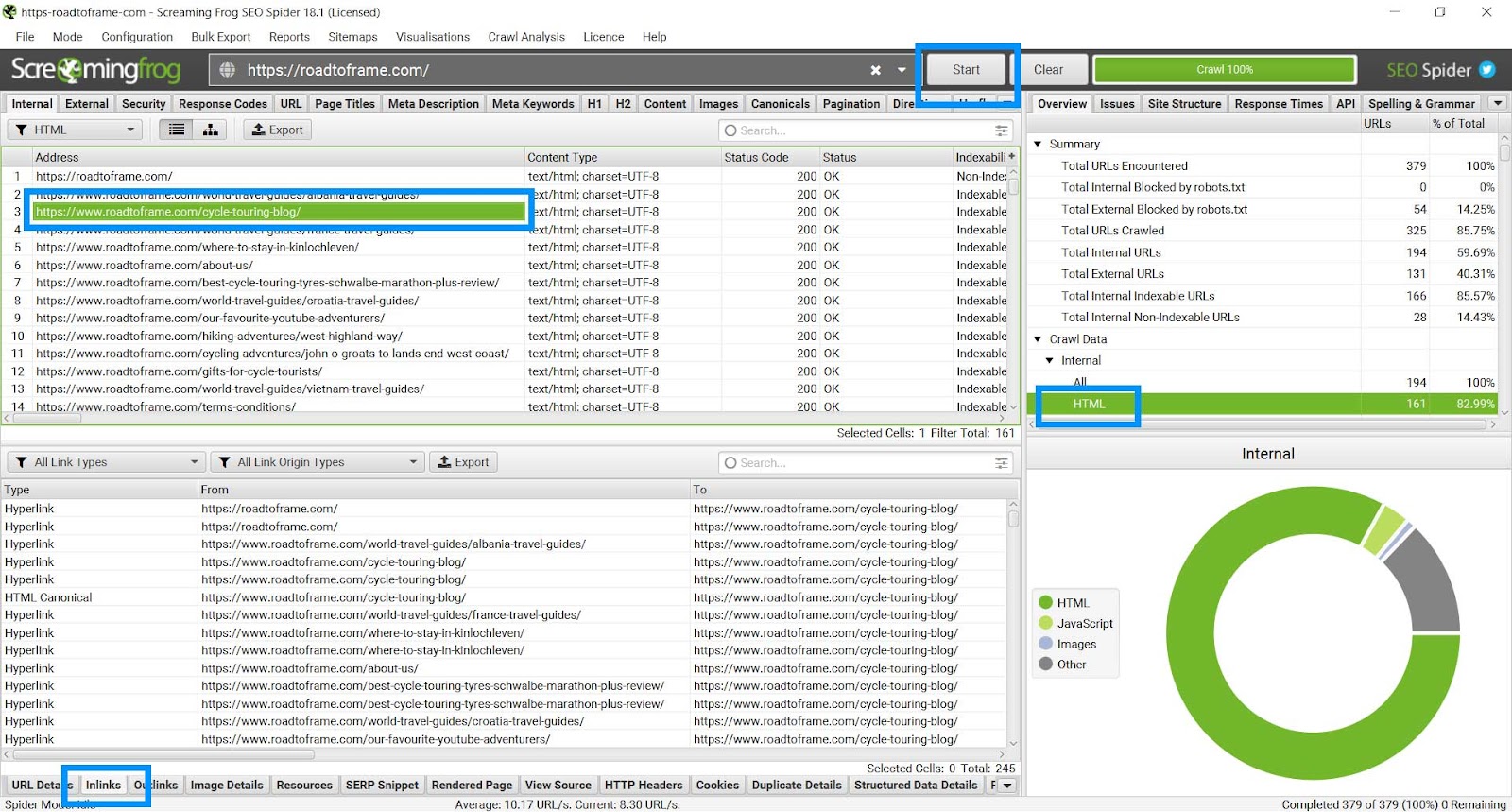
Open Screaming Frog, then click crawl your site. Filter by HTML, click the page you want to view, then hit inlinks.

Annotated screenshot of Screaming Frog showing the steps to analyze internal links to help solve keyword cannibalization issues.

You'll see which pages link to your page and with what anchor text. With a quick edit you can straighten out your internal linking strategy.

Pro tip: When building a content plan, prepare a content database (like a Google Sheet) where you can pick a keyword from the cluster to use in your anchor links. This process prevents writers from adding random internal links in their articles.

Refining keyword clusters and establishing clear search intent

Perhaps you've identified keyword cannibalization but want to keep the two pages. In this case, you might need to give each piece a defined purpose. 

To do this, develop a keyword cluster and establish clear search intent. Each piece of content must do something unique.

Using the Delish example from above, we can see that although similar, the two articles have clear search intent. 

  • One article recommends lunch ideas for work.
  • The other recommends packed lunches. 

Taking a packed lunch to work is synonymous with a work lunch, but it isn't just for work purposes.

Content consolidation and 301 redirects

It's fairly intuitive when you need to do a content consolidation and a 301 redirect. Mostly, you can tell immediately if a page is targeting the exact same keyword.

Going back to the Delish example, although similar, the two pages on healthy lunches have two different intents. As mentioned, one article focuses more on lunches for work, and the other is about packed lunches.

Although nuanced, the two content pieces can co-exist assuming they're not causing issues behind the scenes.

However, if the two articles were "55 Healthy Lunches" and "The Best Healthy Lunches," there is an issue.

The target keyword is clearly similar – "healthy lunches" and "best healthy lunches." Sounds like the same thing, right?

To confirm, a quick search of  "healthy lunches" and "best healthy lunches" returns almost the exact same SERPs.

So, these articles would be consolidated, and one would be redirected to the other.

How to fix keyword cannibalization with content consolidation and a 301 redirect

Before consolidating two (or more) articles, do your due diligence. Use data to help you decide which URL you're keeping and which one you're redirecting.

  • Consolidate the content in the two articles. When you do this, make sure you give it a thorough edit. You'll do more bad than good if you end up with Frankenstein-esque content. To succeed with this tactic, your content must be high-quality and well-written. 
  • Find the most successful URL by looking at Google Search Console data. Filter by page to see which URL receives the most clicks, impressions and average position. Generally, one will supersede the other a lot, so the choice will be obvious.
Annotated screenshot of Google Search Console showing the page filter.
  • If the winning URL doesn't jump out at you by this point, check the backlink profile. Although you will redirect one link to the other and carry over those backlinks, keeping the content on the URL with the strongest backlink profile would be better.

Add a canonical

If the two pages need to exist but you don't want Google indexing both, you could add a canonical. 

This method is useful on ecommerce websites, particularly Shopify sites, where the same product exists on multiple URLs.

We can see the canonical in action on Helm's Shopify website.

Their Xander Olive shoe exists on two URLs:

  • https://ift.tt/LhOIdpz 
  • https://ift.tt/V3Jtpnv

A search within the code of the /collections/ URL shows the canonical pointing to the product.

Screenshot of Helm website showing canonical in their code.

How to avoid cannibalization in the future

Cannibalization issues occur when there's no clear plan for content production. Without a plan, well-intentioned writers can deliver similar pieces of content. 

To avoid cannibalization, keep a content log and monitor the following:

  • Focus keyword: Assign one to each piece of content.
  • Keyword cluster: Detail all other keywords the piece should rank for.
  • Content pillar/topic: This helps visualize all content under a certain topic.

The closer you are to your content and its purpose, the less likely you are to create cannibalizing content. It helps to have a strategic SEO professional to guide the process so they can correctly assign keywords. 

If each piece of content fits within a specific pillar or topic, you can filter content by that topic and double check you've not already created content before you write it.

Or, you can use your content research process to identify content that could be edited instead of recreated. Sometimes, a good edit on an existing article can do wonders for your SEO.

The post A guide to keyword cannibalization in SEO and how to fix it appeared first on Search Engine Land.


a message brought to you by Wayne Vass SEO

This article first appeared on: The post %%POSTLINK%% appeared first on %%BLOGLINK%%.
0 Comments

Why content strategy matters most

2/27/2023

0 Comments


Does your brand have a strategy behind its content marketing?

It should.

Planning is integral to achieving that ever-elusive return on investment (ROI).

Even if you’re not a natural planner, you’ll probably agree that most tasks are easier to achieve if you plan first.

For instance, planning your meals for the week vs. winging it. Going grocery shopping with a planned list vs. nothing. Planning a trip vs. stepping off the plane with no idea what you’ll do or where you’ll go.

Some people get excitement from living life in the unknown. But, for most of us, whether we want to save money, eat healthier, or get a seat at that hip restaurant on vacation, planning is essential.

The same is true of content marketing.

Without a strategy, your content marketing efforts are far more likely to go nowhere and do nothing.

I’d argue that profitable content marketing is impossible without a solid content strategy. 

To answer the inevitable “why?”, let’s discuss why content strategy matters most.

But first, what is a content strategy?

What is a content strategy?

A content strategy is a plan that lays out how you will ideate, create, publish, promote, and manage content.

A content strategy helps define your brand’s goals, workflows, guidelines, budget, team structure, and content rules. It definitively answers these questions:

  • Why are we creating content? (What goals are we trying to reach?)
  • Who are we creating content for? (Who is our target audience?)
  • How will we create content? (Will we use in-house talent? Hire writers/graphic designers/videographers?)
  • What content will we create? (What topics and formats will we focus on?)
  • Where/when will we publish content? (On our website? On social media?)
  • How will our audience find our content? (How does SEO tie in?)
  • Who is in charge of managing, publishing, and promoting our content? (What does our content team look like, and who fills what role?)

All of these questions are vital to answer if you create content. And if you formulate a content strategy, all of them will be addressed before you publish a single article. That’s key.

Why a content strategy is your map to profitable content

If you’ve been paying attention, content strategy is a huge deal.

Why?

Because smart content marketing gets incredible results, and those results will cost 62% less to achieve than traditional or paid advertising.

But to get those results, you need a strategy, because a strategy is a map that will lead you to profitable content that earns ROI. Here’s why.

1. Businesses with successful content have a content strategy

97% of businesses reported using content marketing as part of their overarching marketing strategy, according to a Semrush survey. However, only 57% reported having a documented strategy, and a mere 19% said their strategy was advanced.

The clincher? 78% of businesses who said their content marketing was “very successful” also had a documented content strategy.

Use of content marketing

What does it all mean? 

Most businesses use content marketing, but many aren’t realizing its full potential.

To do that, you need a content strategy. And, you need it documented.

It matters because, without a documented plan, your content efforts will be scattershot. And scattershot efforts lead to scattershot, unpredictable results.

That is, if you earn results at all.

2. No content strategy? No results

Here’s what doing content marketing without a strategy looks like:

A small brand decides to start a blog. One or two staff members who also happen to be creative are tasked with managing it. 

They’re not sure where to find topics, so they look at what their competition is doing and follow suit. They post whenever they have time, so publishing is sporadic and scattered. They post about the topics their main competitor posts about with little differentiation. And when the brand gets busy, the blog falls silent for months.

A year later, the brand checks in with the blog results – and finds none. They conclude blogging is a waste of time.

Yes – in this instance, it is. But that’s because the brand in question started wrong from the get-go. They treated content marketing as an accessory that could be done in spare minutes of the day without much effort.

The truth is, if you want content marketing to work, you have to regard it as another vital business activity – and a content strategy helps you get there.

You need to plan how, when and why to do it, and who you’ll do it for. You need to strategize so your brand can post consistently and regularly (because consistency leads to better results) – and that will require more than somebody’s spare time. 

Reality check: It will require dedicated effort from someone whose 9-5 work consists of content creation and nothing else. 

How will you direct that person? How will you allocate the resources to employ or pay that person? How do you ensure the created content will earn results? You have to plan. You need a content strategy.

3. A content strategy aligns your people, processes, and technology

If you want results from content, you must ensure your entire brand and team are on the same page, working under the same expectations and toward the same goals.

A documented content strategy aligns all those things like puzzle pieces snapping together to form a complete picture.

Think of building a content strategy as laying out your battle plan for increasing brand awareness, drawing in more website traffic, nurturing your audience, increasing conversions and sales, or whatever goal you decide is most important. 

Achieving these goals will require many moving parts, different people, and plenty of tools (like a publishing platform, SEO tools, a content calendar, social media scheduling tools, editing tools and content checkers, collaboration tools, and more).

But the strategy accounts for all these pieces and explains how they fit together.

That’s why you and your team should make decisions about and record the who, what, where, when, and why so your content has its best chance of succeeding.


Get the daily newsletter search marketers rely on.

Processing…Please wait.

See terms.


4. A content strategy helps you win buy-in 

As we've explained, you need investment to ensure content marketing can work. You don't just need people who will plan, create, manage, promote, and distribute content. You need people who know what they're doing. And you need tools your people can use to facilitate all of those stages.

But what if the marketing budget isn't up to you? Then you need buy-in from higher-ups.

How do you get content marketing buy-in? By laying out a strategy with goals, a trajectory, metrics to track, and a budget. 

The strategy serves as proof that you know what you're doing. Even further, it serves as a detailed guide for other people on how you plan to execute content successfully. 

That makes it a powerful document to have on your side when you're working to earn buy-in from bosses, department heads, clients, executives, and anyone else who holds power to invest.

5. A content strategy gives you a competitive edge

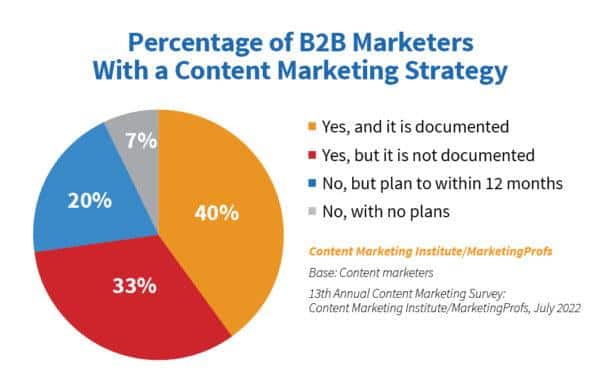
Only 40% of marketers say they have a documented content strategy, according to a recent Content Marketing Institute survey.

This statistic hasn't budged in the last few years.

Percentage of B2B marketers with a content strategy

But, year after year, marketers with a documented strategy outperform their peers who don't have one.

For that reason, they have a competitive edge. You need a documented strategy guiding everything you do in your content marketing to earn that edge over the competition.

The power of a content strategy lies in the finished document and the physical act of creating it. 

When brands sit down to figure out this content thing, they crystallize key areas vital to success:

  • Clarifying and refining their content goals.
  • Getting to the heart of who they need to target with content.
  • Envisioning what that content should look like.
  • Strategizing how to execute with a clear set of actions like a blueprint.

With all this in mind, we shouldn't be surprised that marketers who strategize content and write down that strategy are regular top performers. 

Bottom line: If you want that competitive edge, you'll join that club.

Your content marketing is more likely to fail without a content strategy

A content strategy at the heart of your content marketing will determine whether your efforts will fly – or fall flat.

Unfortunately, most brands are approaching content marketing with a laissez-faire approach. They might even be getting "okay" results. 

But the thing is, "okay" should not be the standard. 

That's because content can achieve great heights for any brand, regardless of industry or size.

Think of that: Content has immense power to grow your brand.

But to tap into that power, you must have a content strategy.

The post Why content strategy matters most appeared first on Search Engine Land.


a message brought to you by Wayne Vass SEO

This article first appeared on: The post %%POSTLINK%% appeared first on %%BLOGLINK%%.
0 Comments

Bing AI Chat testing setting the tone of the responses

2/27/2023

0 Comments


Microsoft is testing a new setting for “tone” in the new Bing AI search and chat experience. You can set the tone to be creative, balanced, or precise to tailor the type of responses you get from the Bing AI chat.

What it looks like. Here is a screenshot posted by Mike Davidson, Corporate Vice President, Design & Research at Microsoft, on Twitter:

What it does. Mike Davidson said, “some users will see the ability to choose a style that is more Precise, Balanced, or Creative.” I personally do not see this feature yet, so I cannot really test it out, but Microsoft is testing it to a subset of those invited to test the Bing Chat AI feature.

By the description, either Bing will respond with a more precise, maybe factually accurate response or a balanced response that shows multiple sides of the argument, or creative, maybe a response that is a bit more out there.

More changes to Bing AI chat. In addition to the above experiment of setting a tone, I noticed other updates to Bing AI chat this weekend.

  • New daily limit of 100 queries per day
  • Search queries are not included in the limit
  • The Edge sidebar limits are a fixed number
  • A new tagging system to help Bing disambiguate parts of the query
  • Tone of voice changes
  • Relaxing some constraints
  • And inviting more users to test the new Bing AI chat

Why we care. It is fascinating to follow all these rapid changes from Microsoft on its new Bing AI Chat. Keeping an eye on what Microsoft is doing to improve the quality of the results, how it responds to criticism, and more is something that is not just fun and exciting to stay on top of, but may teach us about how we can leverage these features to garner more traffic to our sites.

The post Bing AI Chat testing setting the tone of the responses appeared first on Search Engine Land.


a message brought to you by Wayne Vass SEO

This article first appeared on: The post %%POSTLINK%% appeared first on %%BLOGLINK%%.
0 Comments

This day in search marketing history: February 26

2/25/2023

0 Comments


Google expands mobile-friendliness as a ranking signal

In 2015, Google announced it would expand its use of mobile-friendliness as a ranking signal, beginning April 21.

This algorithmic change would have a “significant impact” in the mobile search results, impacting all languages worldwide, Google said.

However, when April came, the general consensus was that Mobilegeddon was fairly insignificant, for all the hype and panic their Feb. 26 announcement created.

Google also announced that apps indexed by Google through App Indexing would begin to rank better in mobile search. Google said this only will work for signed-in users who had the app installed on their mobile device.

Read all about it in Mobilegeddon Cometh: New Google “Mobile Friendly Update” To Reward Sites Beginning April 21.


Also on this day


How to identify your products for Google

2021: Google published a list of best practices to help ensure that its search engine understood the products that were being referenced. 


Google mobile-first indexing to be applied to all sites within a year

2020: Google was sending notices to sites that had mobile-first indexing issues. 


Create display network exclusion lists with this (free) tool

2020: A tool for those tired of manually weeding through placement reports to exclude inappropriate websites and apps from display campaigns.


Google Search Console now lets you export more data

2020: Search Console users could download complete information (instead of just specific table views) from almost all reports.


Google search view in 3D now live for e-commerce sites

2020: A Burberry bag was showing up with a “view in 3D” option in the Google search results.


Google to kill off property sets within Search Console

2019: Google said you could download the data from the interface or the API before they turned it off completely.


Google Ads to sunset average position reporting metric later this year

2019: Average position was one of the few constants for more than 15 years. But with the removal of right rail ads, in particular, its utility sharply declined.


Google call-only ads getting ‘expanded’ with more characters

2019: The other change was that name of the business would move to the description line.


Google releases Mobile Scorecard & Impact Calculator tools to illustrate importance of mobile page speed

2018: One tool showed how a site stacks up against the competition on mobile. The other aimed to drive home the impact mobile speed can have on the bottom line.


Google confirms bug with crawl stats in ‘time spent downloading a page’ Search Console report

2018: Google’s John Mueller confirmed a reporting glitch with the crawl stats “time spent downloading a page” report in the Google Search Console for on Feb. 20 and 21.


In response to EU antitrust ruling, Google Shopping now shows ads from competing shopping engines

2018: In a new structure, the Google Shopping business unit bid against other Comparison Shopping Engines in the ad auction to give the competing engines “equal treatment” as mandated in the ruling.


Google Word Coach, a fun word game in the search results

2018: Google added a new feature to help non-English speakers expand their English-language vocabulary. 


Google: AMP Not Yet A Search Ranking Signal

2016: Google’s John Mueller said you could use AMP to become mobile-friendly, but AMP itself was not a ranking signal.


Google Confirms Review Stars’ Mysterious Disappearance In Search Results Was A Bug

2016: Google review snippets returned after a bug caused them to drop out of much of the search results for about a week.


AdWords And Bing Ads Both Having Late-Week Reporting Troubles

2016: Google AdWords reports weren’t downloading or printing. Bing Ads had reporting delays that affected the Web UI, mobile and API.


Google App Updates Will Include New Animations & Ability To Change Google Logo Colors

2016: Users would be able to change the color of the Google logo using a “finger painting-like” feature.


Search In Pics: Coca Cola Google Cardboard, Googley Volvo & Animated Google Sign

2016: The latest images showing what people eat at the search engine companies, how they play, who they meet, where they speak, what toys they have and more.


Google’s Matt Cutts: While Scientific Content Is Great, Clarity & Focusing On The Searcher Is Important

2014: Cutts answers the question: “Should I focus on clarity or jargon when writing content?”


Movie Sites Ranking Better In Google, Now That “Transient Issue” Fixed

2014: Rankings were restored and most traffic was returning to the affected websites.


Hiding From That Google Penalty? It May Find You At Your New Home

2014: Even if you moved your penalized site to a new domain name and didn’t redirect the penalized site, Google might still find it and pass along the bad signals.


AdWords Flexible Conversion Counting Officially Launched, Welcome “Converted Clicks” and “Conversions”

2014: The company officially announced the launch of Flexible Conversion Counting, and advertisers would see new columns in AdWords.


Google Shares Performance Stats On Search Network With Display Select Campaigns

2014: Google released some case study performance results on the new campaign type.


FOX Partners With Google To Allow Voting For American Idol On Google’s Search Results

2014: All you had to do was go to Google, search for [american idol] or [idol] during the voting window, and select from your favorite finalists.


Google Brings Back Right-Click-For-Directions To Google Maps

2014: Users could also use the “What’s Here” option to quickly get lat-long coordinates for any spot on the map.


Baidu Posts 50 Pct. Revenue Growth But Shy Of Investor Hopes

2014: The company announced $1.573 billion in Q4 revenue, a 50.3% increase over 2013.


Welcome Martin Beck, Who Joins Third Door Media From The Los Angeles Times

2014: Beck was Third Door Media’s Social Media Reporter from March 2014 through December 2015.


Google Panda Two Years Later: 5 Questions With HubPages CEO Paul Edmondson

2013: Edmonson confirmed that Panda “caused a massive loss of traffic and revenue.” But HubPages wasn’t planning to change course; the planned was to improve quality.


The Hidden Google Search Box

2013: It seemed as if Google was testing hiding the search box completely from the Google search results page.


Number Crunchers: Who Lost In Google’s Panda Algorithm Change?

2011: The biggest “content farm” type brand that seemed to have suffered was Associated Content.


Yes, More Are Seeing A New Google Look-And-Feel

2010: Testing would continue until May, when it launched the new user interface.


Google Adds “Nearby” Local Search To Options Panel

2010: Google expanded the choices in its Search Options panel with the announcement of a tool to refine searches by location.


Google’s Street View Finds More Trouble In Europe

2010: Members of the European Union’s data protection group urged Google to make changes to its Street View mapping/photo service and warned that Google might be breaking EU laws.


Google News Officially Adds Advertisements

2009: After testing ads for the past few months, Google News officially rolled out ads on Google News search results to all US based searchers.


Google Gets On Twitter

2009: The first tweet was in binary and translated into “Feeling Lucky.” 


Google Maps Adds User Photos To Street View

2009: Google added geo-tagged Panoramio photos to StreetView images.


Report: Lack Of Buying Searchers Leading To Depressing Search Ad Market

2009: Rimm-Kaufman shared early first quarter PPC data showing the weak trends in retail for search advertisers.


Yahoo Search Updating: Weather Reports Go Away?

2009: Yahoo eventually did issue a weather report confirming that there are ongoing updates that would be “completed very soon.”


Yahoo Adds Facebook As A SearchMonkey Friend

2009: Yahoo announced that Facebook enhanced results were now turned on by default across search results.


Yahoo CEO Bartz: New Management To Make Yahoo “A Lot Faster On Its Feet”

2009: “For us working at Yahoo!, it means everything gets simpler. We’ll be able to make speedier decisions, the notorious silos are gone, and we have a renewed focus on the customer.”


Google AdWords Launches Limited Beta Test Named “Automatic Matching”

2008: Automatic Matching was a way for Google to help advertisers utilize their full budget towards keywords that they may have not been targeting.


Google Updates AdSense Terms & Conditions

2008: Google updated their AdSense terms and conditions to include better verbiage for new products and features, as well as an update to their privacy requirements.


Despite Takeover Turmoil, Yahoo Not Rolling Over & Playing Dead

2008: Yahoo CEO Jerry Yang said the Microsoft takeover bid had been “a galvanizing event for everyone at Yahoo.”


Minimum Bids In Yahoo About To Change

2008: Minimum bids could be lower or higher than $0.10.


Yahoo To Announce “Search Monkey” Enhanced, Annotated Results At SMX West

2008: Yahoo planned to unveil a project code-named “Search Monkey,” a set of open-source tools that allow users and publishers to annotate and enhance search results associated with specific websites.


Yahoo Buzz Launches: Votes, Searches, & Emails Used To Rank News

2008: Yahoo Buzz was a site where “buzz-worthy” news articles were highlighted based on user votes,
searching activity, and email sharing. 


Google Talk / Gmail Adds Live Chat & Invisible Mode Features

2008: The first feature was similar to a live chat box that you could add to any webpage and chat with anyone via your Google Talk or Gmail account.


Google Joins “Unity” Undersea Cable Consortium For More Transpacific Bandwidth

2008: Google joined a consortium of Asian companies to build an undersea transpacific fiber optic cable that would provide much greater bandwidth capacity between the United States and Japan.


Google AdWords To Show Advertisers Exactly Where Their Contextual Ads Are Displayed

2007: Google’s advertiser reports would begin listing the sites where each ad runs.


Google Steps Up Web Page Malware Notifications

2007: Google was giving more detailed reports on the malware issues with a specific site and they were also sending email notifications to webmasters about these malware warnings.


Google Video Plus Box Results

2007: Spotted in the wild.


Google Checkout Australia Coming Soon?

2007: It appeared that Google registered Google Payment Australia PTY. LTD. in Australia.


Google Ordered To Change AdSense Contract By South Korea’s Watchdog

2007: The Fair Trade Commission said the contract enabled Google to “one-sidedly cancel advertisement deals” with publishers.


Microsoft To Buy Health Search Engine Medstory Inc.

2007: Microsoft plans on building out a specialized search engine focused on delivering medical information to consumers.


Video Search Challenge Isn’t Speech Recognition, It’s Content Owner Management

2007: The real challenge was figuring out how to work with content owners, not speech recognition.


Pew Research: Wireless Internet Grows

2007: Pew asserted that roughly 13.5% of U.S. Internet users were accessing the Internet over mobile phones (or their equivalents).


From Search Marketing Expo (SMX)

  • Know your site. That’s how you stay ahead of algorithm updates (SMX West 2020)
  • Tips For Optimizing Your Local Business Listings, Courtesy of SMX West (SMX West 2009)
  • SMX West 2008 Day One Coverage

Past contributions from Search Engine Land’s Subject Matter Experts (SMEs)

These columns are a snapshot in time and have not been updated since publishing, unless noted. Opinions expressed in these articles are those of the author and not necessarily Search Engine Land.

  • 2019: Stop the silo madness! Effective site architecture for SEO and findability by Shari Thurow
  • 2019: Maximize Facebook performance by leveraging the algorithm by Amanda Farley
  • 2019: Google’s next chapter for metrics to focus on clarity once ‘average position’ is removed by Frederick Vallaeys
  • 2018: 6 smart e-commerce lessons to boost local business by Wesley Young
  • 2016: Connecting Demographics To Search Queries by Andrew Ruegger
  • 2016: Prioritizing Local Search Profile Listings: 2 Methods by Lydia Jorden
  • 2015: The Importance Of Search Data In Your Marketing by Alistair Dent
  • 2015: The Hardest AdWords Quiz You’ll Ever Take by Larry Kim
  • 2014: 6 Tasks To Automate In AdWords Without Scripts Or Tools by Sam Owen
  • 2013: 3 Major Tablet & Smartphone Search Opportunities For Multinational Websites by Chris Liversidge
  • 2013: The Link Shrink Is In: Is Starting Over The Best Option? by Eric Ward
  • 2010: It’s A Fatal Mistake To Copy Successful Web Sites by Kim Krause Berg
  • 2010: Click to Conversion Time & Your Revenue Attribution Window by Siddharth Shah
  • 2009: Should YouTube Sponsored Video Ads Be In Your Marketing Mix? by Eric Papczun
  • 2009: SEO 3.0 = Digital Asset Optimization by Jonathan Ashton
  • 2008: How Depending on Quality Content Can Actually Cost You Links by Rae Hoffman
  • 2007: 3 Jump-Start Methods For Passionate Linking by Debra Mastaler

< February 25 | Search Marketing History | February 27 >

The post This day in search marketing history: February 26 appeared first on Search Engine Land.


a message brought to you by Wayne Vass SEO

This article first appeared on: The post %%POSTLINK%% appeared first on %%BLOGLINK%%.
0 Comments

This day in search marketing history: February 25

2/24/2023

0 Comments


SEOs upset over Google dropping attribution in featured snippets

In 2019, SEOs were not happy about a Google featured snippet format that didn’t immediately show the source of the content.

For the Found on the web card, searchers had to click to expand the featured snippet and then scroll through various sources to see the publisher.

Danny Sullivan, Google’s Search Liaison said Google’s support of the overall ecosystem (searchers, advertisers and publishers) is important. “We don’t thrive & users don’t thrive unless the ecosystem thrives.”

This is an incredible search result from Google:

• Answers a fairly complex question
• Takes the copy of many 3rd party publisher to create its own independent web page
• Zero visible on-page links to the publishers who provided the data

This is the future of Google Search pic.twitter.com/txNU2Z7HB5

— Cyrus (@CyrusShepard) February 23, 2019

The future of Google search, indeed! Amazingly, you could write a very similar tweet in 2023.

Google’s recent preview of its generative AI search results featured answers to complex questions that were made possible after being trained on content created by third-party publishers, with a grand total of zero links to publishers. Déjà vu!

Read all about it in Controversy over Google Featured Snippets stealing publisher traffic reignites.


Also on this day


IndexNow integrations grow as Bing says ‘millions’ of sites are using it

2022: Duda, All in One WordPress SEO plugin and Rank Math SEO plugin gained IndexNow support.


LinkedIn launches podcast network aimed at professional audiences

2022: The pilot program included shows about topics such as technology, recruiting and mental health, from external experts as well as its own in-house news team.


Google Images to replace dimensions overlay on image thumbnails

2020: Google would instead show product, recipe, video, and soon, licensable labels in place of that dimensions information.


How to use the AMP status report to identify page errors, validate fixes

2020: Google posted an explainer for its AMP (accelerated mobile pages) status report.


‘Made in USA’ ad extensions spotted on Bing

2020: A “Made in USA” label accompanied by a flag icon appeared to be the latest automated ad extension test by Microsoft Advertising.


Google revamps Test My Site mobile site speed tool

2019: Test My Site (which launched in 2016) was rebuilt with more features details on a site’s mobile site speed.


Nearly half of users have a bad reaction to ‘not secure’ browser warning, survey finds

2019: Survey found the flag affected user behavior and brand perceptions.


Google Assistant everywhere: more dedicated buttons, expansion on lower-end phones

2019: The company also was adding local search suggestions in Messages.


Google Explains How Search Console Reports Work

2016: Google Webmaster Trends Analyst John Mueller explained how the Search Console reporting works and why it may seem delayed for some of the reports.


Google Testing A Red “Slow” Label In The Search Results For Slower Sites

2015: The slow label would indicate if a particular webpage was slow and warn the user before clicking over to the site that it may load slowly.


Yes, Google Is Testing Green Star Reviews In The Search Results

2015: Google said expect more experiments with the colors of the stars in the search results over the next few months.


Study: Google Now Displays Rich Answers For 19.45% Of Queries

2015: 19.45% of the 850,000 search queries looked at in the study triggered rich answers.


Yahoo Gains Share And Query Volume In Latest comScore Search Report

2015: Firefox deal powered the second straight month of growth for Yahoo search.


Ray Kurzweil’s Job At Google: Beat IBM’s Watson At Natural Language Search

2014: His sole job at Google was to make the company’s computers as smart as humans – smarter, actually – when it came to natural language understanding.


The Marquee HTML Google Easter Egg

2014: When you searched for [marquee html], the results count would scroll from right to left on the page.


Bing Improves Tax Related Search Results Before April 15th

2014: Bing showed smarter results when you searched for [tax forms], [IRS forms], or even specific forms like [irs form 1040].


Quixey Offering Deeper Search Results Inside Mobile Apps

2014: Quixey, which described itself as a search engine for apps rather than an alternative app store, announced deeper “functional search” within apps.


Google Panda Two Years Later: The Real Impact Beyond Rankings & SEO Visibility

2013: A look at what happened to some Panda’s losers.


Google: PageRank Dilution Through A 301 Redirect Is A Myth

2013: There was no more dilution of PageRank with a 301 redirect when compared to using a normal link.


Europeans Taking Sweet Time In Resolving Antitrust Case With Google

2013: Any possibility of swift action in Europe appeared to be fading.


YP: Our Mobile Ad Network Second Only To Google

2013: YP said it had “over $350 million in advertising revenue [in 2012] attributable to mobile, making it the number two company in the US mobile advertising industry.” 


WSJ Pulls Back On What Google Searchers Can Read For Free

2012: The Wall Street Journal has been keeping some stories out of First Click Free for over half-a-year.


Demand: Google Changes Have Produced “No Material Impact” Yet

2011: Demand Media said its properties were not negatively impacted by the newest Google algorithm change (which would eventually become known as the Panda Update).


Google’s Mobile Search Adds “Open Now” Filter

2011: After doing a Google search, the “Show only businesses open now” filter appeared above the search results.


Report: Google Negotiating With DOJ To Prevent Suit To Block ITA Deal

2011: Negotiations intensified in the waning days of the Justice Department’s investigation into the antitrust implications of Google’s potential acquisition of travel software company ITA.


OneRiot Brings Social Targeting to Mobile Devices

2011: Social ad network OneRiot introded the ability to target mobile audiences by interests, demographics and influence on its ad network of Twitter clients.


Google Caffeine May Be Months Away & You Can’t See It

2010: Google said Caffeine wasn’t live on Google.com, was only at one data center and you couldn’t easily see it for yourself. 


Google Advertises Chrome … On Bing!

2010: Google confirmed that they placed these ads and that they were always looking for ways to promote their products. 


Companies Ask Courts, Regulators To Restrain Google To Compensate For Own Competitive Failures

2010: A Foundem complaint/brief with the FCC argued that Google favored its own products and thus “search neutrality” was required to prevent Google from harming competitors.


Losing Google? Chinese Scientists Say It’s Like Going Blind, Life Without Electricity

2010: 84% of Chinese scientists surveyed said that losing Google would “somewhat or significantly” hamper their research; 78% said that international collaborations would be impacted in the same way.


Opera Says Google Dominating Search On Mobile Web

2010: Google had a lead comparable, almost exactly, to its market share on the PC in the U.S.


Yahoo Answers Gets A New Look

2010: Yahoo announced a fairly substantial overhaul of how Yahoo Answers looked and worked.


Google Toolbar 6 For IE Adds Search To Windows Task Bar

2009: This toolbar, when installed, added the Google Quick Search Box to the task bar of Windows computers.


Google Joins EU Anti-Trust Case Against Microsoft Browser

2009: Google’s move to some degree reflected how important it considered Chrome and its adoption to be in the long term for the company.


Microsoft’s TechFest 2009 Is A Search Playground

2009: Hundreds of Microsoft researchers from around the world gathered at company headquarters to share ideas and show off their latest creations.


Yahoo Mobile Head Boerries To Leave, How Will It Affect Yahoo Mobile?

2009: Yahoo had seen the mobile space as strategic and made a massive global business development effort with carriers and device makers to embed Yahoo services and search on millions of handsets.


Penn State Study: Paid + Organic Listing = 15% Clickthrough Rate

2009: Study also found that 35% of queries did not result in any ad clicks ad all.


SEOs Want The NOINDEX Tag To Not Show A Page In The Index

2008: When asked “How should Google treat the NOINDEX meta tag?” 240 chose “Don’t show a page at all.”


Survey Says: Google Top Brand In UK

2008: Microsoft was second in this survey.


Hackers Launch Goolag: A Google Vulnerability Scanner

2008: A group of hackers launched a search tool powered by Google to help see if your sites were vulnerable to a hacking attempt.


Pakistan YouTube Ban Propagates Worldwide, Causing Major YouTube Outage

2008: The Pakistan ban of YouTube not only caused Pakistan ISPs to block YouTube, but also spread worldwide and stopped users even in the U.S. from accessing YouTube.


Yahoo, You’re Not Off The Hook Over The Chinese Dissidents Case Says New Lawsuit

2008: Yahoo was being sued again for allegedly leaking personal information and aiding the Chinese Communist Party in Internet censorship and the persecution of dissidents.


Ask.com Adds More Sponsored Ads, Pushing Organic Results Below Fold

2008: Ask.com was displaying five sponsored results for many keyword searches.


Andy Beal Launches Trackur For Monitoring Online Reputation

2008: You coud set up monitoring across a variety of sites on a set of keywords at a much lower price than reputation management firms generally charged.


From Search Marketing Expo (SMX)

  • SEO dos and don’ts of website migration (SMX Next 2021)
  • Smart Shopping campaigns: How to test and extract more value from automated campaigns (SMX West 2020)

Past contributions from Search Engine Land’s Subject Matter Experts (SMEs)

These columns are a snapshot in time and have not been updated since publishing, unless noted. Opinions expressed in these articles are those of the author and not necessarily Search Engine Land.

  • 2020: Competition forces retailers to rethink the role of branded, non-branded and trademark traffic by Chris Corrado
  • 2019: Content structure and structured data: Will they impact featured snippets? by Brodie Clark
  • 2019: Think like a search marketer to drive growth with YouTube by Matt Lawson
  • 2016: Setting Local SEO Expectations: 3 Points To Hit Early And Often by Jenny Foster
  • 2016: Google Is Fixing The “Permanently Closed” Problem by Joy Hawkins
  • 2016: The Death Of Search Marketing Expertise by Andrew Goodman
  • 2015: How To Use Fetch As Googlebot Like An SEO Samurai by John Lincoln
  • 2015: How Travel Advertisers Should Actually Be Using Search Marketing Benchmarks by Lori Weiman
  • 2014: The Secret To Staying Relevant With Authorship by Jim Yu
  • 2014: When The Best SEO Move Is To Kill The Site by Eric Ward
  • 2013: Is Social Media Worthwhile For Local Businesses? by Chris Silver Smith
  • 2013: 3 Neuromarketing Considerations For Landing Page Optimization by Mona Elesseily
  • 2013: Why Do Brands Overlook The SEO Opportunity For Non-Branded Keywords? by Eric Enge
  • 2011: Interview With Hampus Jakobbson Part II: Plugging Into The Grid by Gord Hotchkiss
  • 2011: How To & When To Use Google Ad Extensions: Phone & Local Extensions by Carrie Hill
  • 2011: Designed To Fail: Why Many Tests Give You Meaningless Results by Siddharth Shah
  • 2010: Extending The Lifecycle Of Super Bowl Ads Through Online Video by Eric Papczun
  • 2010: The Advertiser Interview: How To Surface Key Goals by Josh Dreller
  • 2010: Local Search Complexity = SMB Frustration by David Mihm
  • 2009: B2B & Social Marketing: Discovering Its Hidden Value by Michelle Stern
  • 2008: The Secret Of Large Term Lists (It’s All In The Bidding) by Alan Rimm-Kaufman

< February 24 | Search Marketing History | February 26 >

The post This day in search marketing history: February 25 appeared first on Search Engine Land.


a message brought to you by Wayne Vass SEO

This article first appeared on: The post %%POSTLINK%% appeared first on %%BLOGLINK%%.
0 Comments

The GA4 migration deadline is right around the corner

2/24/2023

0 Comments


Google is sunsetting Universal Analytics (UA) on July 1st. Starting in March, Google will automatically create Google Analytics 4 (GA4) properties for any customer who does not set up a GA4 property with basic settings.

If you do not opt-out of auto migration by February 28, 2023, Google will transition your UA account to GA4 without any custom strategy. To ensure accurate tracking and analysis, you should make the switch to GA4 now and customize the setup as needed.

GA4 is much more than just a new “version” of Google Analytics. It’s a completely new platform – built from the ground up to collect, process, and report on data differently than before. Migrating to GA4 is a complex and integral process that requires strategic planning and expert implementation.

Need help? This 5-minute GA4 preparation guide from MoreVisibility will provide the insight and assistance you need to get started. Visit Digital Marketing Depot to download the GA4 Preparation Guide.

The post The GA4 migration deadline is right around the corner appeared first on Search Engine Land.


a message brought to you by Wayne Vass SEO

This article first appeared on: The post %%POSTLINK%% appeared first on %%BLOGLINK%%.
0 Comments

An SEOs guide to ChatGPT prompts

2/24/2023

0 Comments


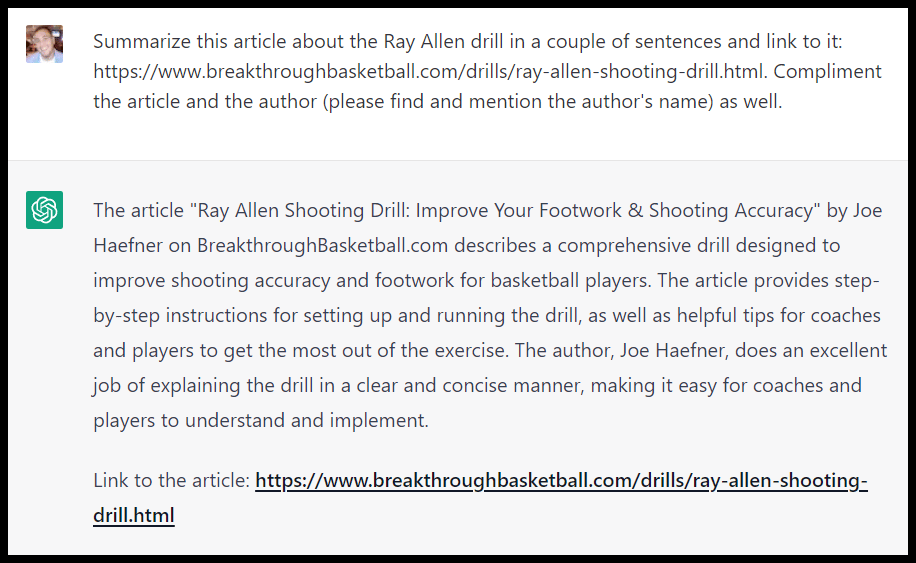
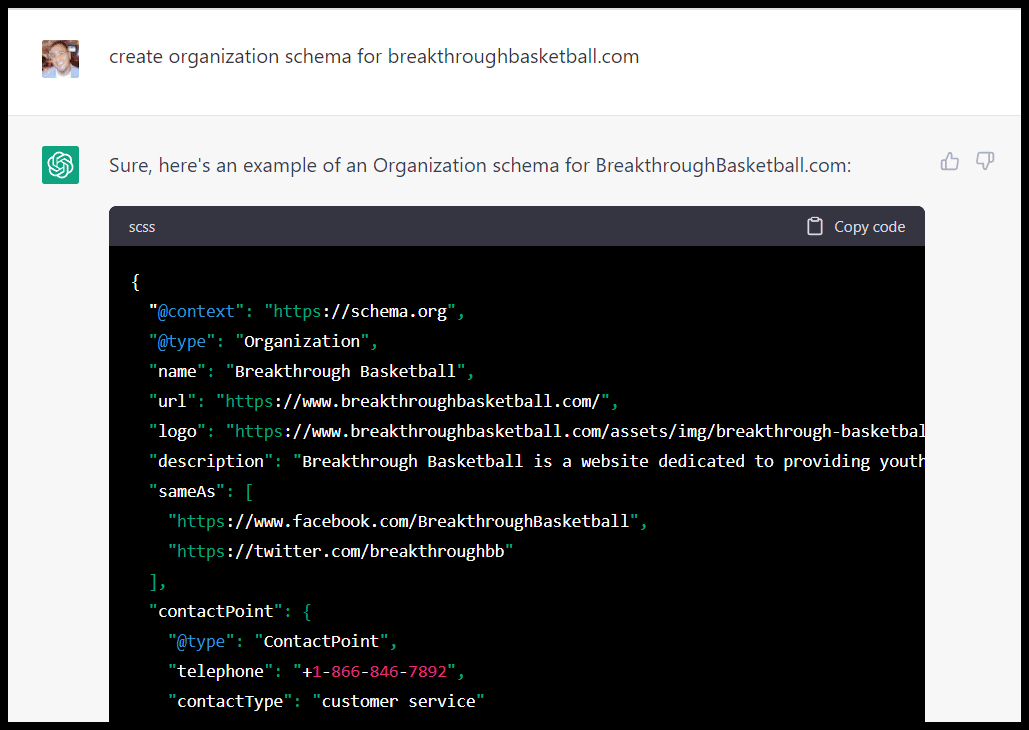
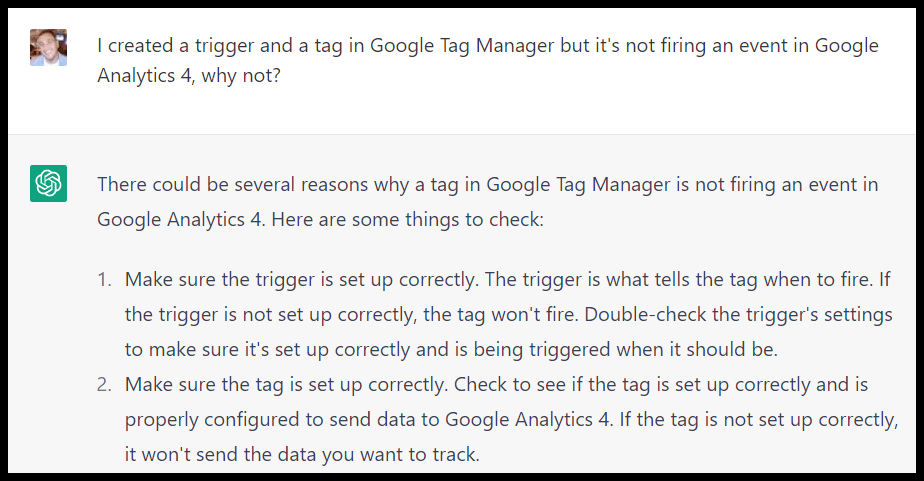
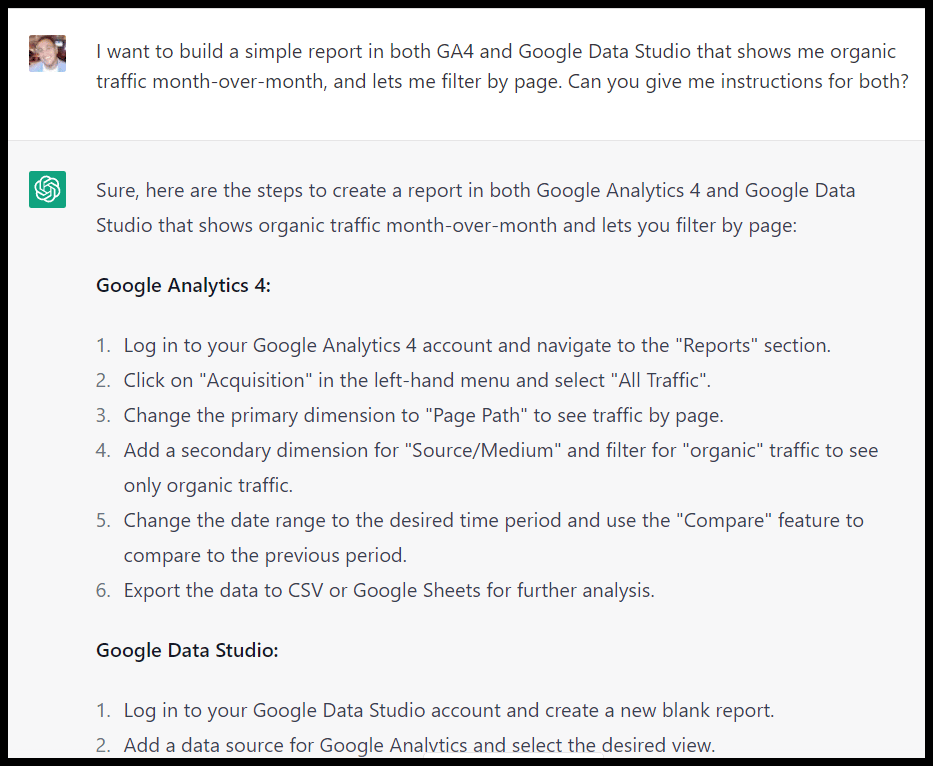
For weeks, marketers have been hearing about ChatGPT and its applications for content and SEO. 

Prompt engineer is even now a job:

Wow – Anthropic (Google's latest $300M AI investment) is hiring a "Prompt Engineer" for $250k-$335k/yr + equity

No CS degree required, just have "at least basic programming and QA skills"

Wild times. pic.twitter.com/4i1sEWs5iZ

— AI Breakfast (@AiBreakfast) February 14, 2023

I won’t pretend to know which SEO and digital marketing functions ChatGPT and AI software will and won’t replace. But becoming an expert at creating prompts for these tools can already be a valuable skill (and will likely increase in value over time as the tools improve).

This article will discuss what to keep in mind when creating ChatGPT prompts for SEO and share an extensive list of SEO-focused prompts to use in your day-to-day work.

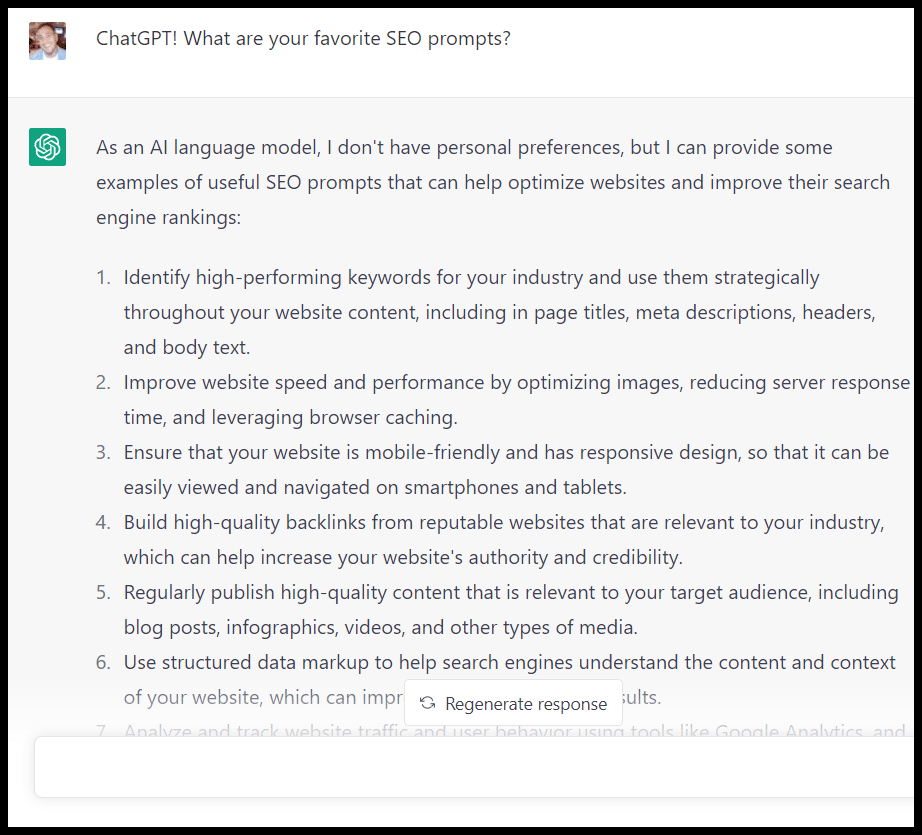
ChatGPT favorite SEO prompts

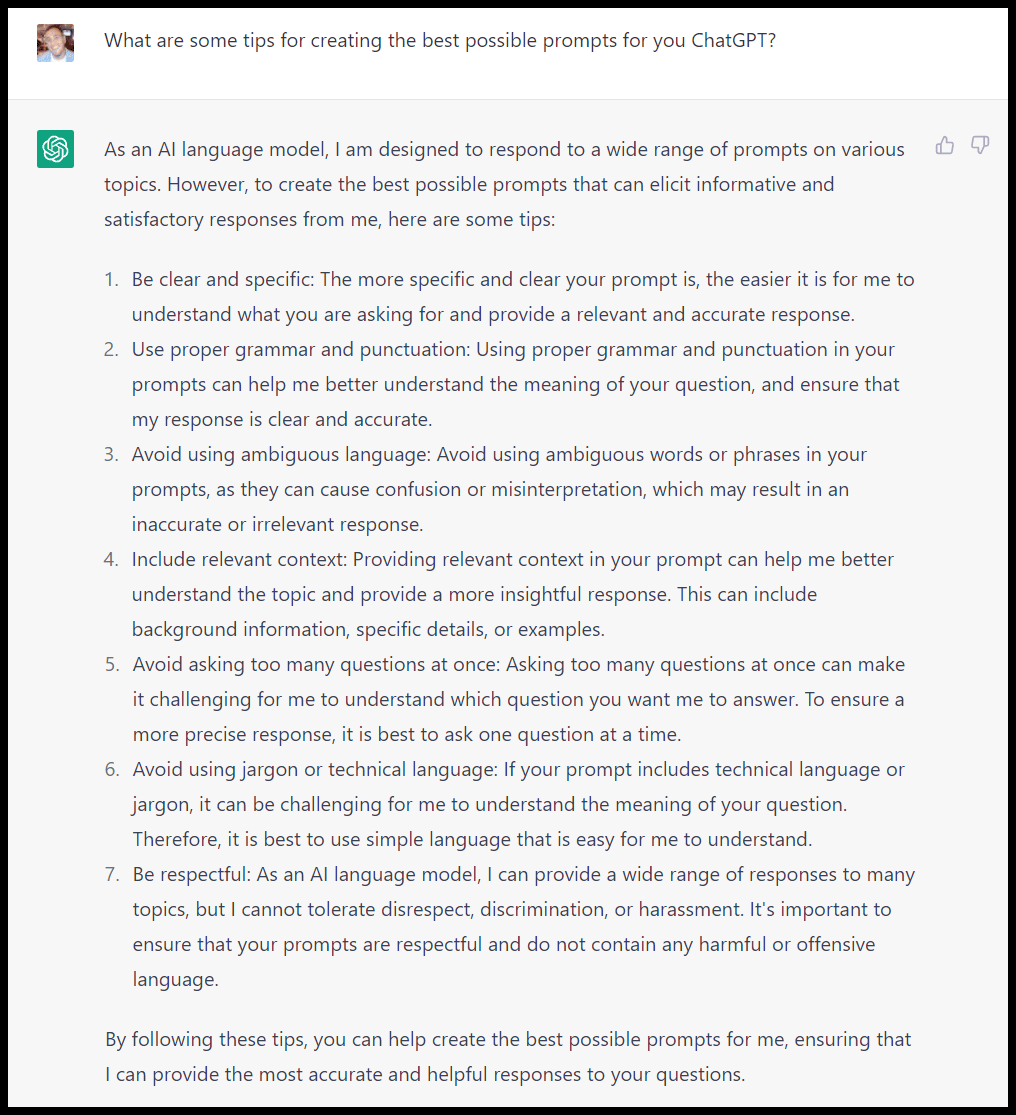
ChatGPT prompt engineering strategy

Before getting into specifics, it is helpful to have a general approach to ChatGPT prompts (and AI chat / writing prompts) so that you can create prompts for your specific applications and be aware of great SEO prompts other folks have come up with.

ChatGPT prompt engineering strategy

First, it’s vital to understand ChatGPT’s limitations:

  • ChatGPT is trained on a large data set and finished training in early 2022, meaning not all of the information is up to date and – as you likely know as a user of the internet – not everything it’s trained on will be correct.
  • ChatGPT does not crawl the web! It has access to information about the web from when it was trained, but it will not go to a page and crawl it (but often, it’s responses will lead you to believe it did or does!)
  • There are a variety of things ChatGPT can get flatly wrong: facts, math problems, code.
  • While it has access to a lot of data and can organize that data in interesting ways, it’s unlikely to have an expert-level of “taste” or knowledge about any individual subject (yet, anyway).
  • ChatGPT wasn’t designed to be an SEO tool, so while you can create prompts for things like keyword research, clustering, link building, etc. keep in mind that it’s responses and suggestions frequently won’t be using the same types of data sets (driven by search popularity and competition) as your favorite SEO tools.

So if you ask ChatGPT for a list, don’t expect it to be curated at an elite level. If you ask it to write code, don’t just assume it will work.

If you ask it to write an article, don’t assume everything it generates will be accurate or well-written (particularly on topics that would require up-to-date information). 

QA is your friend!

I like to think of prompts kind of like I think of tasks like creating a content brief, or using a search operator, or creating an SOW. 

Based on that approach, here are specific tips for crafting a good prompt:

  • Be as clear and thorough with your prompt as possible.
  • Make sure ChatGPT is capable of doing what you’re asking it to.
  • Refine your prompt as you see output, and use your experiences with ChatGPT to inform future prompts.
  • Try to anticipate and address the areas where it may get tripped up as much as possible with the prompt itself.

The best (and worst) ChatGPT SEO prompts

As with most topics, many people are sharing great information about ChatGPT prompts you can use for SEO. And then there are some sharing prompts which are somewhere between mediocre and downright harmful.

Below, I listed examples of what I think are largely “good” (or helpful, to steal a term from Google) prompts and what I think are “bad” (unhelpful to harmful) prompts.

These examples offer specific ideas for prompts that can help make you more efficient, and also some prompts that can get you into trouble (or waste your time).

The good

We’ll start with some useful prompts. Again, I can’t emphasize this enough: QA the output of everything you get from ChatGPT! 

Information can be (dangerously) wrong or misleading and code can break in the worst ways (more on that later in the article).

While Google has stated AI-generated content isn’t explicitly in violation of their search guidelines, it’s certainly possible to get your site into trouble with it.

Keyword and topic brainstorms

Due to the possible downside above, I like to think of ChatGPT as a helpful brainstorming tool for various tasks, including keyword research.

It is particularly useful as an early starting point for getting ideas for keywords and topics.

Let’s assume I’m creating a site aimed at delivering information about coaching for youth basketball coaches:

chatgpt topic idea brainstorm

As someone who is frequently looking for specific youth basketball drills I can tell you that this is a pretty good starting point.

Adding the note about popular websites and not just asking for ideas got me an extra layer of both topics and some examples of suitable sites in the niche. (Again, remember, these are from early 2022 or before!)

Let’s dig a little deeper into keywords:

chatgpt topics and keywords brainstorm

OK, interesting. I wonder how ChatGPT is determining that these are “popular and low competition.”

ChatGPT data sources and keywords

Wow, ChatGPT uses Ahrefs, Moz and Keyword Planner to generate keyword ideas? It only took a few seconds too! 

I felt like my LinkedIn and Twitter timelines would have been flooded with information about this, so I decided to ask a follow up:

ChatGPT wrong answer

So this is not what I asked. I’m getting a “Did you eat these cookies ChatGPT? Well you know the thing about cookies is…” vibe here, but let’s clarify:

ChatGPT clarifies wrong answer

Ah! (Much quicker to apologize than my kids, anyway).

Let’s take a quick look at whether these terms are actually low competition according to Ahrefs, one of the tools ChatGPT initially claimed to have used (tough break for Semrush and other tools here, incidentally):

ChatGPT suggestions - Ahrefs

Yeesh. Well, not much search volume here, but let’s check competition, particularly against this initial claim:

  • “SERP Analysis: I also did a manual search on Google for each keyword to see what kinds of results show up. If the top results are from high-authority websites with strong backlink profiles, it’s a good indication that the keyword is highly competitive. Conversely, if the top results are from low-authority websites with weaker backlink profiles, it’s a good indication that the keyword is less competitive.”
Ahrefs competition ChatGPT suggestions

This isn’t an impossible term competition-wise, though it is likely not feasible for my brand new site any time soon. I can see with the volume for other terms these pages are ranking for that there’s likely search volume in this area generally. 

A popular prompt framework is to get ChatGPT to answer a prompt “as an X” with X being a person with a specific job, level of experience or expertise, etc. 

Let’s see how that impacts things here:

persona prompt

These seem pretty good again! Let’s dig deeper – the combination of volume and competition maybe tripped the tool up. I’ll ask for terms with volume this time:

ChatGPT translate

And let’s see the data on that round via Ahrefs:

Ahrefs unpopular kewyords

Not much better! Keep in mind here that ChatGPT takes my “prompt history” into account for a specific chat, so if I’d opened a new chat and focused more on volume, I may have done a bit better.

Generally, it’s often the case that if you feel like you’re down a rabbit hole with ChatGPT and aren’t getting the data or responses you want, you may want to consider starting fresh and better orienting the tool to what you want.

These prompts and responses are a perfect encapsulation of ChatGPT for a lot of functions:

  • The initial set of results gave a pretty good framework for sites to check out and general topic areas
  • As I niched down and needed to develop specific, actionable plans with search-specific data things got murkier. 
  • Those terms don’t look great in terms of volume, my site can’t rank for those terms, and ChatGPT flat out told me something that wasn’t true about how it generated the suggestions! It also states everything very emphatically.

If I were looking for general topic ideas here, this might have been a useful exercise. 

If I had just started writing (or paying writers) to create content to target these phrases without checking ChatGPT’s suggestions, I might have wasted a ton of time and resources.

Title ideas

You should probably have your own ideas about creating titles and title tags for blog posts, but again ChatGPT can be a good place to generate some ideas:

ChatGPT

List ideas

Similarly list types like X examples, tips, quotes, etc. require some digging to come up with ideas – while you want to curate your own list you can quickly get ideas from ChatGPT:

ChatGPT list ideas

FAQ ideas

To quickly get FAQ ideas for an article the tool can be useful as well – again layering in specific instructions and a persona can help:

ChatGPT FAQ ideas

Content outlines

This is also true for content outlines. Again, keep in mind that tools like Clearscope, Content Harmony, Market Muse, Frase and Surfer SEO are creating briefs and outlines based specifically on what’s ranking in search results, while ChatGPT isn’t.

Here is the prompt I used:

  • “Create an outline for an article about teaching middle school players to move off the ball. The article should be for someone new to coaching basketball but with an understanding of the sport, and is aimed at beginning players. It should include things like: the types of offenses that encourage movement, specific examples of movements players should be making off the ball (cuts, picks, etc.) as well as some specific drills coaches can run to encourage movement.”

And here is the output:

ChatGPT content outlines

Again, not perfect, but a pretty decent framework! 

Keyword clustering

Standard caveats: Clustering is not going to be search-specific like tools like Keyword Insights or similar. It won’t necessarily be driven off of volume and competition, but you can create clusters either semantically or by things like levels of intent:

And/or just add things like search intent as an additional column. 

Summarizing

Be careful with how you use these summaries (as they may get “flagged” as anything from low quality to AI over time). But if you have something like a study or a lengthy article that you want to feature in your own content, (and also let folks know you’ve featured in outreach) in something like a tips list, you can get help there:

ChatGPT summarizing

You can also ask for an outline of an article if you want to understand it quickly.

Technical SEO: Code snippets (schema, hreflang, etc.), robots, .htacess and more

Among the most dangerous ChatGPT prompts of all: code snippets! These can be great time-savers, but again: give as much detail as possible and QA, QA, QA!

A simple prompt along the lines of “Wrap FAQ schema around these questions and answers” will get you the code to copy:

ChatGPT code snippets

Same for different types of schema like organization schema:

ChatGPT organization schema

I have had various schema come back from ChatGPT that didn’t work when rendered on a live page, so again, be sure to check everything.

You can also have a robots file created:

ChatGPT robots file

And create rewrite rules. Be careful, though! (More on this later)

ChatGPT rewrite rule

Meta descriptions

A lot of SEOs or people responsible for maintaining lots of pages hate creating meta descriptions. This is really a perfect function for ChatGPT:

ChatGPT metadescription

Google Tag Manager, Google Analytics 4, Google Search Console and Looker Studio

You can get troubleshooting ideas for these platforms:

ChatGPT platform troubleshooting

Get instructions for building specific reports:

ChatGPT GA4 and Data Studio reports

Or even get code to use to interface with their APIs:

ChatGPT GSC API code

Translation

You can translate text to create country-specific pages:

ChatGPT translation

Formatting 

As an SEO, many quick and simple formatting tasks come up where ChatGPT can be very helpful. Things like converting a page to (or from) HTML:

ChatGPT HTML formatting

Extract links from a page:

ChatGPT extract links

(It missed the distinction between internal and external links here, obviously.)

You can also take a list of URLs and extract just the domains from them or convert a list of sites into HTML links (or vice versa).

Additionally, you can perform some functions you might typically perform in spreadsheets (which may or may not be more helpful than just performing them in spreadsheets, depending on your proficiency with spreadsheets and workflow).

Instead of concatenate or having to find a list of cities / copy and pasting a list of states:

ChatGPT spreadsheet functions

In place of VLOOKUP / IF types of functions, you can create a prompt like:

  • “Create lists of basketball drills from site A and site B, then show me A) the drills they both cover and B) the drills that are missing from each list that the other covers.”

Code for simple tools and widgets

As I walked through in this article, you can use ChatGPT to help you build simple tools like calculators that can enhance content, give you a chance to rank for specific terms (like {subject} calculator), and give you something to promote via outreach.

Rewrite content

If you give ChatGPT specific instructions on things like tone and what to include, it can help you rewrite or flesh out content:

ChatGPT rewrite content

Outreach assistant

While ChatGPT can’t find contact information for you (at least for now), there are some specific outreach tasks it can perform.

Like getting a list of ideas of places to guest post:

ChatGPT outreach assistant

Or drafting a template for an outreach email. This is potentially particularly valuable if English isn’t your first language:

ChatGPT outreach assistant template

Infuse your prompts here with your own tone and content preferences to make sure the template you get is closer to being consistent with your typical outreach emails.

You can even craft an entire auto-responder sequence:

Or you could create different types of outreach lists:

ChatGPT outreach lists

And as you work through the outreach process, you can likely find even more opportunities to leverage ChatGPT.


Get the daily newsletter search marketers rely on.

Processing…Please wait.

See terms.


The bad

In my experience, most of the trouble you'll run into with ChatGPT will be:

  • Asking the tool to complete a process whole-cloth for you (rather than particular functions).
  • Not providing enough oversight.

Publications have already been accused of publishing AI-generated content with errors and plagiarized content. 

If we'd unleashed ChatGPT to do all of our keyword research for us, we likely wouldn't have gotten a lot of traction.

When you try to assign it tasks like strategy, you'll often get the same kind of boilerplate advice you'd get from a beginner-level X tips article on Google:

ChatGPT marketing plan

And without a lot of human input (specific prompts, editing, and likely a mix of human and AI content weaved together), you'll likely get warmed-over content.

Depending on your purpose (and your risk threshold), that may be fine.

You may not need your meta descriptions, FAQs or certain articles or pages to be "10x". But make sure you understand what you're getting.

The ugly

Of course, some areas, like health-related content or critical tasks, on your site can go sideways:

??? The AI has already started messing with us.

I recently used ChatGPT to fix some .htaccess code for a side project

Rather than deindexing part of my site, it noindexed the entire site. I only realized 5 days later

When I asked ChatGPT, it could easily find the mistake

— Thomas Jepsen (@JepsenThomas) February 13, 2023

Be particularly mindful of ChatGPT's limitations 

When it comes to ChatGPT prompts and SEO, you want to proceed with caution.

Get good at creating your own prompts and sourcing inspiration (or productivity enhancements) from prompts other people share.

Here are a few great articles with additional SEO prompts for ChatGPT:

  • Joe Hall's list of technical SEO prompts.
  • Authority Hacker's list has some prompt ideas I haven't seen elsewhere.
  • Aleyda Solis has a comprehensive list.
  • Kristin Tynski consistently shares some great advanced ChatGPT prompts and scripts for various content and SEO-related tasks.

The post An SEO’s guide to ChatGPT prompts appeared first on Search Engine Land.


a message brought to you by Wayne Vass SEO

This article first appeared on: The post %%POSTLINK%% appeared first on %%BLOGLINK%%.
0 Comments
<<Previous
Forward>>

    Author

    Write something about yourself. No need to be fancy, just an overview.

    Archives

    April 2023
    March 2023
    February 2023
    January 2023
    December 2022
    November 2022
    October 2022
    September 2022
    August 2022
    July 2022
    June 2022
    May 2022
    April 2022
    March 2022
    February 2022
    January 2022
    December 2021
    November 2021
    October 2021
    September 2021
    August 2021
    July 2021
    June 2021
    May 2021
    April 2021
    March 2021
    February 2021
    January 2021
    December 2020
    November 2020
    October 2020
    September 2020
    August 2020
    July 2020
    June 2020
    May 2020
    April 2020
    March 2020
    February 2020
    January 2020
    December 2019
    November 2019
    October 2019
    September 2019
    August 2019
    July 2019
    June 2019
    May 2019
    April 2019
    March 2019
    February 2019
    January 2019
    December 2018
    November 2018
    October 2018
    September 2018
    August 2018
    July 2018
    June 2018
    May 2018
    April 2018
    March 2018
    February 2018
    January 2018
    December 2017
    November 2017
    October 2017
    September 2017
    August 2017
    July 2017
    June 2017
    May 2017
    April 2017
    March 2017
    February 2017
    January 2017
    December 2016
    November 2016
    October 2016
    September 2016
    August 2016
    July 2016
    June 2016
    May 2016
    April 2016
    March 2016
    February 2016
    January 2016

    Categories

    All

    RSS Feed

Powered by Create your own unique website with customizable templates.